One of the lovely things about establishing our new gardens at Earth Rhythms has been finding places for the plants that accompanied us from our previous home.
Some have been patiently waiting in pots, while others have been divided or propagated so we can gradually increase our collection.
Amongst these is one of my newer Yarrows, The Pearl.
As I don’t have seeds for this particular variety, I’ve been carefully propagating it to ensure we have more plants for our gardens.
But it seems this Yarrow brought along a little surprise.
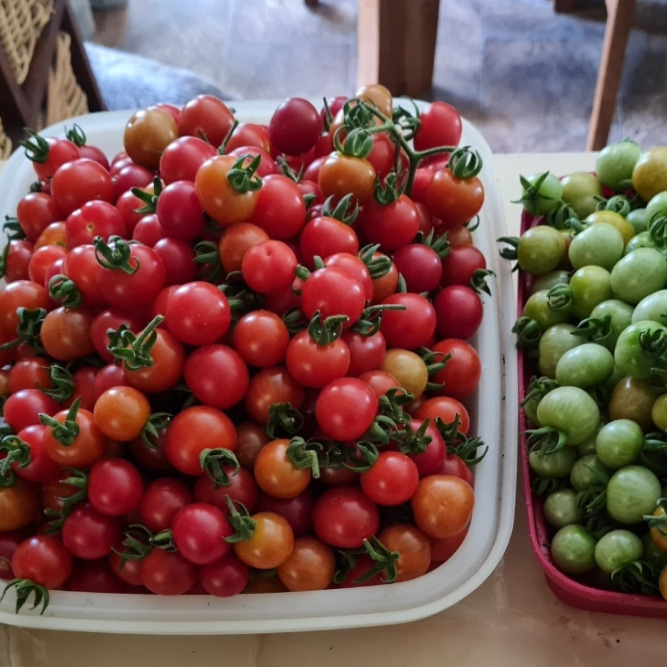
Growing amongst it were some unexpected tomato seedlings, most likely descendants of the cherry tomatoes that grew at our previous property. So I planted these up in a separate pot.
And these particular tomatoes have quite a history!
The week we moved into our previous property one of the six big pines across the back fence came down in strong winds. We ended up removing three of these large pine trees due to risk and the moment we did, cherry tomato plants began appearing randomly throughout the lawn and gardens.
Every year, more would pop up.
We never quite knew where we’d discover the next plant, but they certainly rewarded us with plenty of tomatoes.
Over the years, those unexpected little plants provided the ingredients for some delicious pasta sauces and green tomato chutney. Freddie our boxer cross also got a good feed from them from time to time also.
And now it seems they’ve decided to accompany us on our next adventure.
I’m rather looking forward to seeing whether our little seedlings continue the family tradition of appearing wherever they please!
As we establish Earth Rhythms, there’s naturally a great deal of attention being given to everything new.
New garden beds, new plants, new pathways and new possibilities.
But amongst all this transformation, there’s something especially meaningful about the things we’ve chosen to bring with us.
Our gardens aren’t simply a collection of new beginnings.
They’re also home to plants we’ve nurtured, enjoyed and shared experiences with over many years.
Transformation doesn’t always mean leaving everything behind. Sometimes it’s about allowing what we love to take root somewhere new.
And I think there’s something rather beautiful about that.
A Little Reflection
As you move through different chapters of your life, what are the things you choose to carry forward?
What continues to nourish you?
And what memories, experiences or traditions would you like to see flourish in the next chapter?
We arrived here on the property with planting calendars.
The land, it seems, has its own.
Something rather strange is happening at Earth Rhythms this year. Spring has technically only just begun, but looking around the garden, it feels as though nature has been working from an entirely different calendar.
The weather has been all over the place. We’ve had cold days , we’ve had winter, but we’ve also had unusually warm spells — including days this month already that have felt much more like summer than spring.
There have been moments when I’ve wondered whether we’re going to jump almost directly from a somewhat mild winter into summer without spring getting much of a look in at all.
And the plants seem just as confused as me.
When we moved here to the farm, we brought a pot of marigolds with us from our previous garden. I expected them to eventually finish flowering as the colder weather arrived.
They didn’t.
They managed to simply keep going.
Then there were the quince trees already growing here. They began flowering in early winter rather than waiting until late winter, giving us another little clue that the usual seasonal rhythm may have shifted.
And then there were my dahlias.
Our Dahlias Didn’t Read the Rule Book
Normally, winter is their time to retreat.
The visible growth disappears, the tubers rest underground and we wait for the warmer weather to wake them again.
Except mine didn’t seem particularly interested in doing that this year.
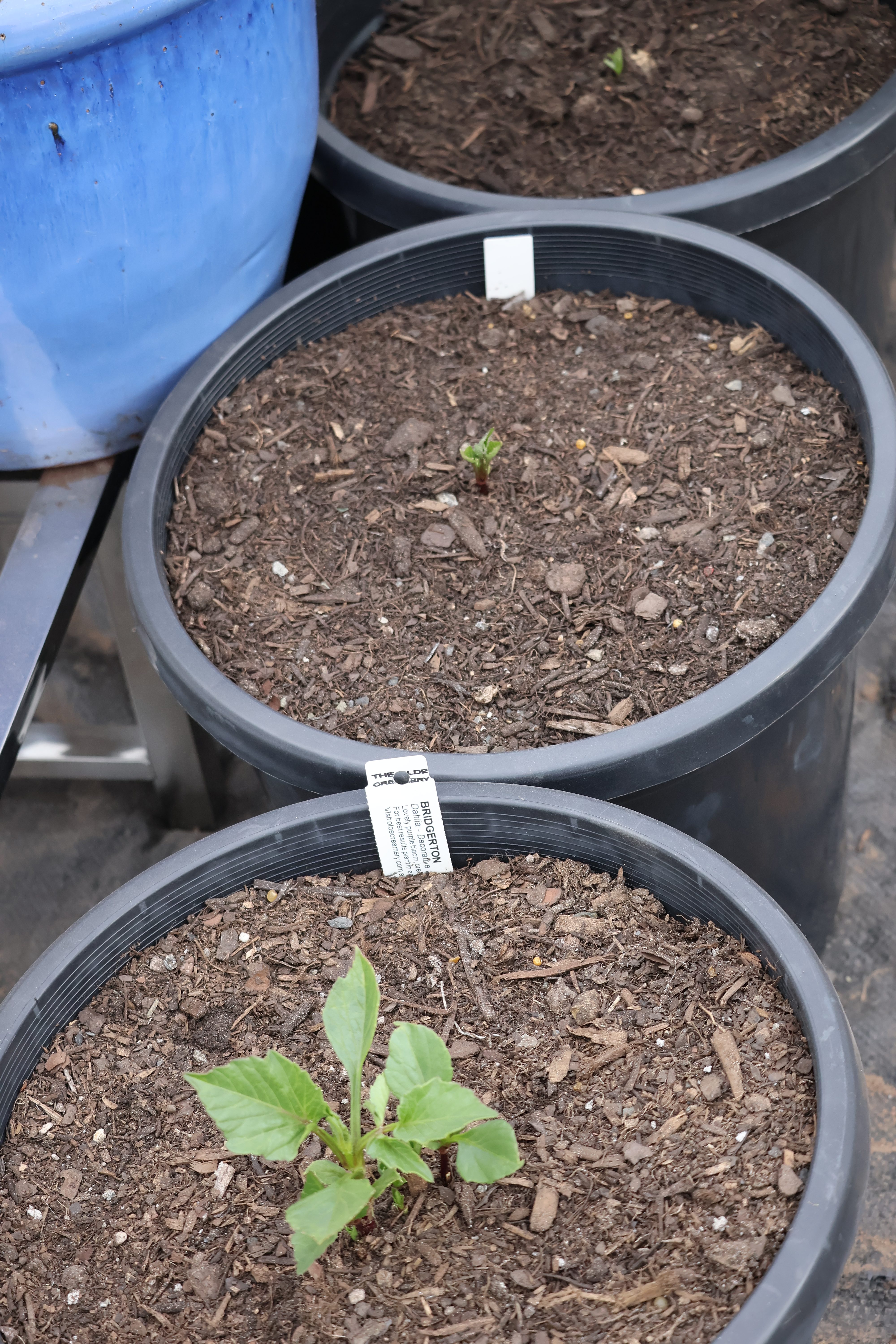
Throughout the colder months, I kept noticing shoots appearing from the dahlias we brought with us still in pots and also from those growing in the gardens here that had been planted by the previous owner.
They weren’t exactly racing away, but they weren’t completely dormant either.
Now the weather is beginning to warm, those little signs of life are becoming much more obvious.
The dahlias are waking up.
Early.
And rather than trying to make them conform to when I think dahlia season should begin, which in previous years has been November due to our cold climate, we’ve decided to work with what they’re showing us.
So the potted dahlias have now been moved into the Hoop House.
Turning an Early Start Into an Opportunity
Moving them under cover gives them some extra protection while encouraging the growth that has already begun.
But it also gives us an unexpected opportunity.
If we can get some strong early growth from these plants, we’ll be able to begin propagating from them before the main dahlia season really gets underway.
Those early cuttings can become entirely new plants for us.
Which means one dahlia tuber waking up ahead of schedule may eventually give us several plants ready to go into the ground later in spring — or perhaps some plants for us to sell.
For a flower farm that is only just beginning it’s first year, that’s rather exciting.
I’ve also taken some of our stored dahlia tubers (those I dug up from my previous garden and some new ones I have brought for this season) and started putting them into pots so we can get a bit more variety growing early.
Instead of seeing this strange season only as a problem, we’re asking a different question:
What opportunity is the season giving us?
Right now, one of the answers seems to be more dahlias.
I’m certainly not going to argue with that.
The Next Generation Is Already Growing
While the tubers are waking up in the Hoop House, our dahlia season has also begun in another way.
A few weeks ago, I sowed a selection of dahlia seeds, and the seedlings are now growing strongly in the greenhouse.
Almost every type I planted has germinated.
Some were quick to appear, while others have taken their time. In fact, a few have only popped through in the last few days.
There is still a few types that haven’t given us anything at all.
Yet.
I’m holding out hope.
Seeing some of the others emerge later has reminded me that plants don’t necessarily work to our timetable — which seems to be becoming something of a theme around here.
So I’m giving those last seeds a little longer before declaring that nothing is going to happen.
For now, we have tiny dahlia seedlings growing in the greenhouse, established dahlias waking from their winter rest, stored tubers being started in pots and plants in the Hoop House that will hopefully give us material to propagate.
Our first proper dahlia season at Earth Rhythms is beginning to take shape much earlier than I expected and I can’t wait to see all the new varieties we have purchased this year growing for the first time.
But an Early Season Has Another Side
Of course, an early start isn’t necessarily good news for everything in the garden.
While the dahlias seem delighted to get moving, I’m looking at some of our spring bulbs and wondering whether we’ve simply run out of spring.
Moving onto Earth Rhythms between March and May meant that some of my planting happened much later than I would normally have liked.
There was a property to move into, gardens to discover and about a thousand other things competing for our attention at the time.
So some of the spring bulbs went into the ground late.
At the start of September the daffodils and hyacinths had only just emerged and are making their way up, but the ranunculus and freesias, which weren’t planted until winter, still haven’t appeared.
And now we’re already beginning to get temperatures that feel much more like summer than early spring.
It leaves me wondering how much time these plants are actually going to get.
Will we have enough cooler spring weather for them to establish, grow and flower before the temperatures really begin to climb?
Or will this simply be one of those seasons where some things don’t go according to plan?
I don’t know yet.
And I think that’s worth documenting too.
Because creating a garden isn’t only about sharing what worked beautifully.
This first year on the farm is going to be full of experiments, things planted later than intended, weather we couldn’t predict, successes we didn’t expect and probably a few things that simply don’t work.
The dahlias may be taking advantage of an early start.
The spring bulbs may end up paying the price for it.
For now, the daffodils and hyacinths are up, I’m still watching hopefully for those first ranunculus and freesia shoots, and we’re waiting to see what sort of spring nature actually intends to give us.
Learning the Rhythm of This Place
One of the things I’m already discovering about creating Earth Rhythms is that there is a difference between having a plan for the land and actually learning to work with it.
We can look at calendars.
We can make planting plans.
We can decide when something is supposed to flower, sleep, wake up or be planted.
And then nature does what nature does.
The marigolds keep flowering.
The quince blossoms in early winter.
The dahlias start shooting when they’re supposed to be asleep.
Some seeds appear almost immediately while others make us wait.
The spring bulbs race against a season that may be moving faster than expected.
And suddenly the plan changes.
Perhaps that’s part of what this first year here is really about.
We’re learning the rhythm of this particular piece of land.
We’re watching what wakes early, what struggles, what thrives, where the frost settles, how quickly the soil warms and what happens when the weather refuses to behave according to the season written on the calendar.
There will be plenty of time in the years ahead to know Earth Rhythms intimately.
For now, we’re observing.
And adapting.
And perhaps learning that gardening isn’t really about controlling nature at all.
It’s about paying attention to it.
Our first spring here may not look anything like the spring I had planned.
But that’s okay.
The dahlias are waking.
The seedlings are growing.
The bulbs are deciding what they’re going to do.
And we’re learning to listen to the land rather than asking the land to listen to us.
Whatever this strange season brings, it will become part of the story of our first year at Earth Rhythms.
And right now, nature seems to be saying:
Forget the calendar. Pay attention to what’s actually growing.
There are some plants that seem to follow us through life, and for me, Rosemary is one of them.
I have grown Rosemary in the garden at almost every place I’ve lived over the years, so I can’t tell you how happy I was to discover quite a number of established plants already growing here when we arrived.
I’ve always loved Rosemary for its fragrance, flavour and the many ways it can be used, but there is another reason I look forward to its flowering each year.
The bees.
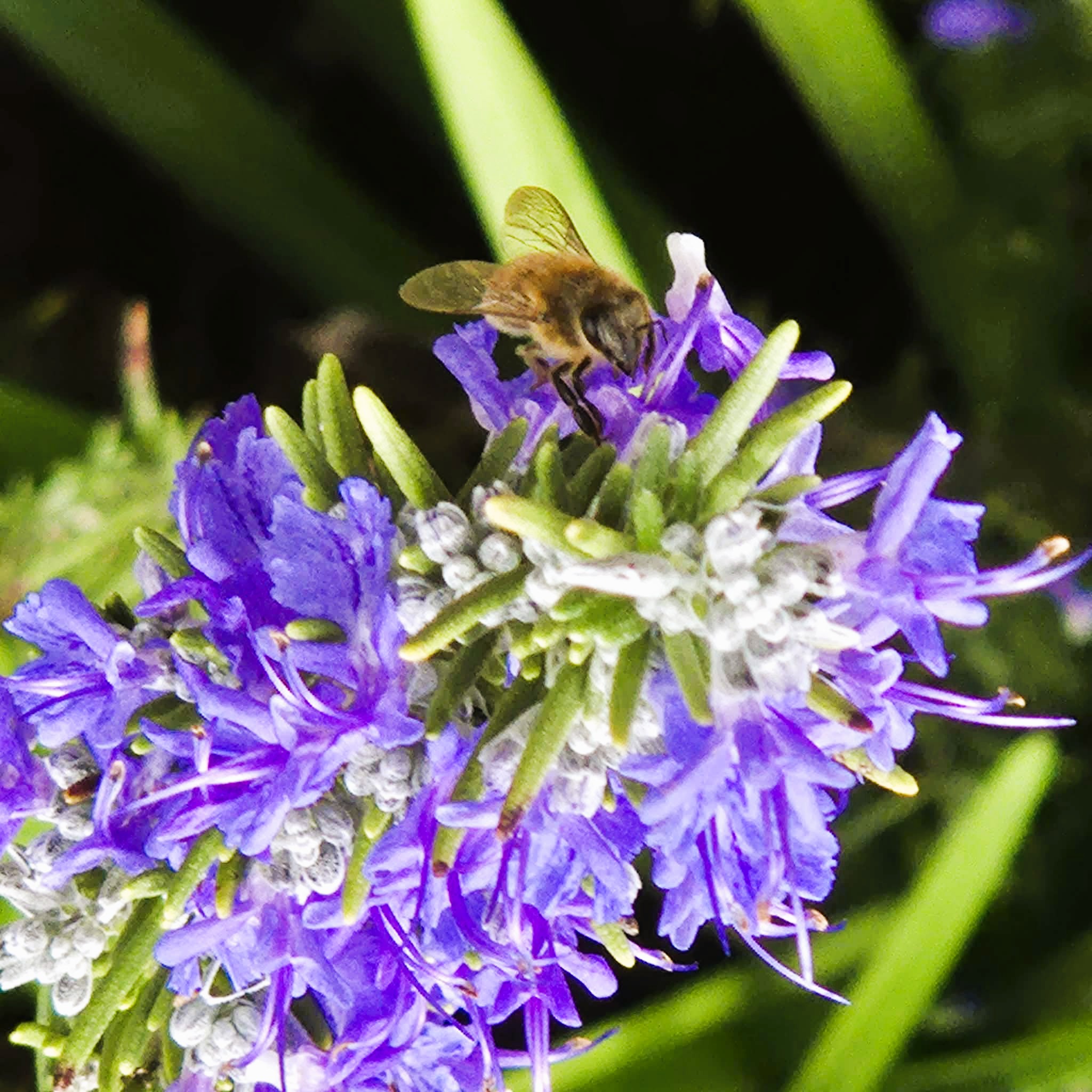
In my previous gardens, Rosemary was often one of the first plants along with Lavender where I would notice the bees becoming more active as Winter began giving way to Spring.
And here, it has happened again.
Just a Few Steps from the Back Door
The Rosemary growing here is flowering more magnificently than any I’ve grown before. There appear to be a couple of different varieties, and right now they’re covered in flowers.
Even better, several plants grow right against the house and around the back deck.
For those who know me, you’ll know how much I love photographing bees amongst the flowers — so lately I’ve only had to wander a few steps from the back door with my camera.
The bees have certainly found the Rosemary.
And I’ve been happily snapping away as they work their way along each of the blooming stems.
Who Else Will We Meet?
One of the things I’m curious about as the weather warms is discovering more of the insects that live here.
I haven’t yet spotted any of the native bees I became familiar with at our previous home, particularly the beautiful Blue-banded Bees that were always a favourite of mine.
But this is only our first Spring.
Already the butterflies are beginning to appear — including my first Monarch sighting — and I suspect there are many more bees, butterflies and other little garden visitors still waiting to make themselves known as the days grow warmer.
For now, though, it is the Rosemary that is bringing the bees close.
A familiar plant in an unfamiliar garden, doing something I’ve watched it do many Springs before.
Flowering, feeding the bees and quietly letting me know that the season is changing.
One of the lovely signs that Spring is drawing closer is appearing on the Tea Trees around the property.
We have a number of Leptospermum growing here, including several planted by the previous owner as part of their small flower-growing business. So far, we’ve identified at least three different types.
This particular one caught my attention this week.
Its delicate, almost rose-like flowers are opening in shades from soft blush through to deeper pink, sometimes with several variations of colour within the one bloom.
They remind me of the beautiful blossom trees such as ornamental plums we traditionally associate with Spring. We have the ornamental plums here on the property starting to bloom also except this is something a little different.
An Australian native putting on its own Spring blossom display.
Through Winter, we had wondered whether some of these plants had survived the drought at all. Their leaves were brown, with barely a hint of green. So many of the plants here were like this and we were not knowing if they were alive or dead.
And now, almost unexpectedly, they are covered in buds, petals and colour.
Another little sign that the garden is changing — and that Spring is almost here.